
A sudden bank collapse. A stock exchange glitch. A social media account shut down. A cloud provider breach. Each failure highlights a growing challenge in today’s digital infrastructure: many critical systems still rely on centralized authorities that users must implicitly trust. A fundamental question emerges: How do we build systems that function reliably when trust cannot be assumed?
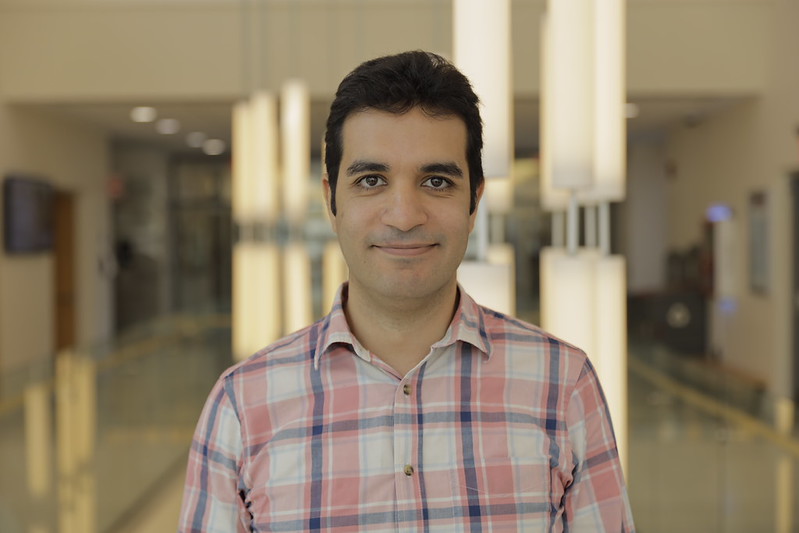
That question drives research by Mohammad Javad Amiri, assistant professor in the Department of Computer Science at Stony Brook University. His newly published book, Blockchain-Enabled Large-Scale Transaction Management (Springer, 2025), co-authored with UC Santa Barbara Professors Divyakant Agrawal and Amr El Abbadi, examines how to manage transactions across networks where parties may distrust each other and infrastructure itself may be unreliable.
For decades, digital infrastructure has largely depended on trusted central operators. Blockchain technologies emerged as an alternative model, introducing cryptographic verification instead of central gatekeepers. However, existing blockchain solutions sacrifice performance and scalability—the ability to process transactions quickly and at large volumes—for security. In so-called Byzantine environments, where some participants or components may behave maliciously, the question remains: how can systems achieve both speed and security?
Amiri's research explores how database system design and blockchain security techniques can be combined to address this tension. His book analyzes architectures that aim to satisfy four critical requirements simultaneously: high performance, strong scalability, data confidentiality, and verifiable correctness.
"It's possible to process a large volume of transactions in untrusted environments efficiently and scalably while still maintaining confidentiality," said Amiri. "This isn't about choosing between security and speed—it's about designing systems that achieve both."
The potential impact extends far beyond cryptocurrency platforms. Amiri's work points toward a range of real-world applications: secure supply chain tracking without intermediaries, allowing manufacturers and retailers to coordinate transparently without needing to fully trust each other. Decentralized finance platforms can operate even when participating entities explicitly distrust each other. Medical institutions can share patient records while maintaining confidentiality. Central banks can deploy digital currencies with both security and scalability. Real estate transactions can bypass title companies. These applications span finance, healthcare, government, and labor markets.
The significance of Amiri's work was recognized in April 2024 when his paper "The Bedrock of Byzantine Fault Tolerance"—developed with researchers from Stony Brook, University of Pennsylvania, UC Santa Barbara, and UC Davis—received the Outstanding Paper Award at USENIX's NSDI 2024, one of computer science's top-tier conferences.
"Mohammad's research addresses fundamental challenges at the intersection of data management and distributed systems," said Samir Das, professor and chair of the Department of Computer Science. "As institutional failures become more common, his work demonstrates that we can build systems that function reliably even when parties don't trust each other—systems that are secure, scalable, and practical. This exemplifies our department's commitment to solving real-world problems."
As digital systems grow more distributed and interdependent, the ability to coordinate securely without centralized gatekeepers is becoming increasingly important. Amiri's research suggests an answer exists—one where security and speed coexist, and decentralized systems compete with centralized ones on performance and reliability.
By Yuganshu Jain